
Business Entity Tax Planning
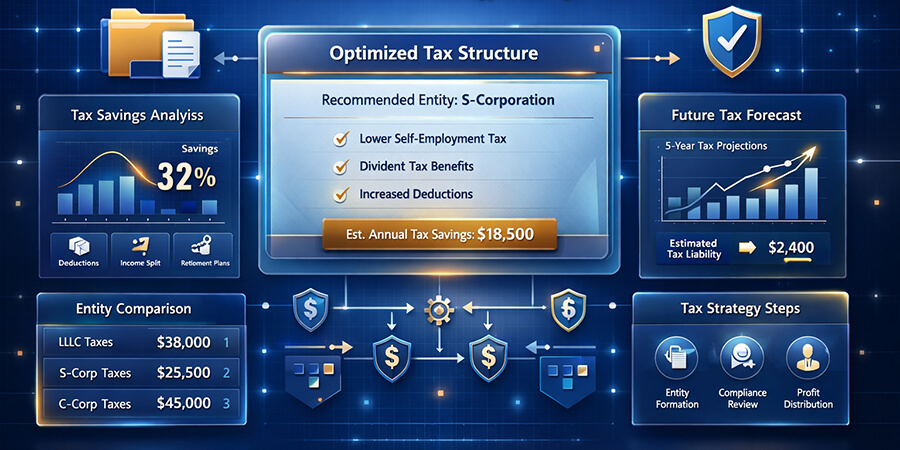
Business entity tax planning is one of the most crucial steps for any business aiming to optimize finances, reduce tax liability, and ensure long-term sustainability. Selecting the right entity and structuring finances correctly can save businesses substantial sums in taxes while maintaining compliance with federal, state, and local regulations.
Why Business Entity Tax Planning Matters
Choosing the wrong business entity can lead to:
-
Higher tax obligations
-
Complex reporting requirements
-
Personal liability exposure for owners
-
Missed opportunities for tax deductions and credits
Proper planning ensures that businesses:
-
Pay the minimum required tax legally
-
Leverage tax incentives
-
Avoid compliance pitfalls
-
Maintain flexibility for growth and scaling
Types of Business Entities and Tax Implications
1. Sole Proprietorship
-
Simplest form of business with minimal administrative burden.
-
Profits are taxed on the owner’s personal income tax return.
-
Limited deductions available; careful planning can reduce taxable income.
2. Partnership
-
Income flows through to partners individually.
-
Each partner is responsible for paying their share of taxes.
-
Requires agreements for profit-sharing and tax liability management.
3. Limited Liability Company (LLC)
-
Flexible structure allowing pass-through taxation or corporate taxation.
-
Protects personal assets while enabling tax optimization.
-
Ideal for small and medium-sized businesses seeking liability protection.
4. S-Corporation
-
Pass-through taxation limits double taxation.
-
Reasonable salaries for owners can reduce payroll tax liabilities.
-
Shareholder distributions are generally tax-efficient.
5. C-Corporation
-
Pays corporate income tax separately from owners.
-
Allows reinvestment of profits at a lower corporate rate.
-
Dividend distributions may be taxed again at the shareholder level, requiring strategic planning.
Key Tax Planning Strategies
1. Timing of Income and Expenses
-
Accelerate deductible expenses to reduce taxable income.
-
Defer income when beneficial to lower tax brackets.
-
Plan for quarterly estimated taxes to avoid penalties.
2. Deductions & Credits
-
Utilize business expenses: travel, software, utilities, and office supplies.
-
Claim tax credits: R&D, energy efficiency, employee retention, and training.
-
Track depreciation on assets to reduce taxable income.
3. Multi-State & International Planning
-
Understand state nexus and tax obligations for multi-state operations.
-
Plan for sales tax collection, reporting, and filing deadlines.
-
For international operations, coordinate with cross-border tax compliance requirements.
4. Payroll & Employee Considerations
-
Optimize salaries vs. distributions to balance income tax and payroll tax.
-
Plan for employee benefits, retirement contributions, and fringe benefits.
-
Maintain compliance with employment tax obligations.
5. Entity Restructuring & Strategic Decisions
-
Evaluate if converting from LLC to S-Corp reduces taxes.
-
Plan for mergers, acquisitions, or bringing in investors.
-
Prepare for potential exit strategies while minimizing tax impact.
Ongoing Monitoring & Compliance
Business entity tax planning is not a one-time exercise. Regular reviews include:
-
Quarterly financial review and tax projections
-
Annual tax filings and audits preparation
-
Adjusting for changes in tax law, business growth, or expansion
-
Continuous assessment of deductions, credits, and compliance
Benefits of Proper Entity Tax Planning
-
Legal minimization of tax liability
-
Improved cash flow management
-
Compliance with federal, state, and local tax rules
-
Protection of personal assets
-
Preparation for growth, investment, and capital raising
-
Ability to withstand audits and financial scrutiny
Summary: Who Should Invest in Business Entity Tax Planning?
-
Startups & small businesses – For establishing the right structure and capturing initial deductions.
-
Growing businesses – For optimizing multi-state taxes and scaling operations efficiently.
-
Large or multi-entity organizations – For advanced tax strategy, entity restructuring, and audit readiness.
Pricing
Our pricing plans
for everyone.
-
Basic Tax Planning
Starting at $150
$150 -
Professional Tax Planning
Most Popular
$499 -
Enterprise Tax Planning
Complete Tax Optimization
$999