
Balance Sheet
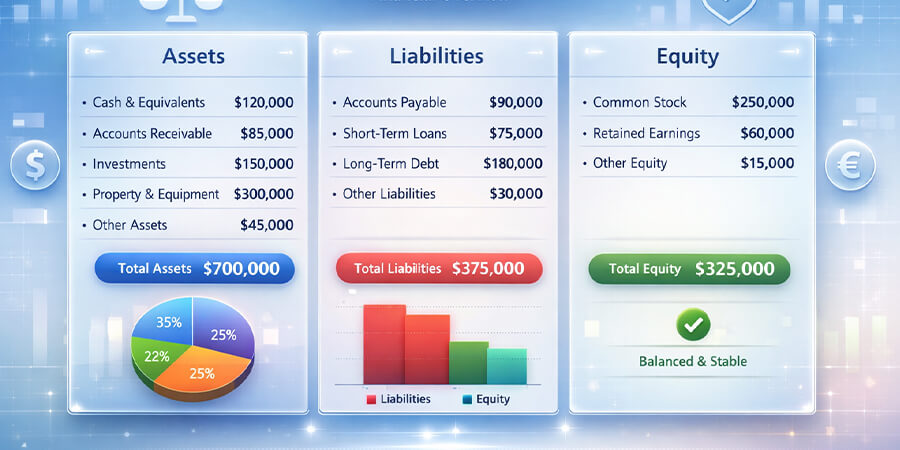
A Balance Sheet is one of the three core financial statements every U.S.-based business must maintain. It provides a snapshot of your company’s financial position at a specific point in time. Unlike a Profit & Loss Statement, which shows performance over a period, the Balance Sheet shows what your business owns and owes on a particular date.
For companies operating in the United States, maintaining an accurate and updated Balance Sheet is essential for tax compliance, loan approvals, investor reporting, and financial decision-making. It reflects the financial health and stability of your organization and helps stakeholders understand whether your company is financially strong and well-managed.
What Is a Balance Sheet?
A Balance Sheet is structured around the fundamental accounting equation:
Assets = Liabilities + Equity
It is divided into three primary sections:
1. Assets
Assets are everything your business owns that has monetary value. These may include:
-
Cash and bank balances
-
Accounts receivable
-
Inventory
-
Prepaid expenses
-
Equipment and machinery
-
Vehicles
-
Property and real estate
-
Intangible assets (software, trademarks, etc.)
Assets are typically categorized as:
-
Current Assets (convertible to cash within one year)
-
Non-Current Assets (long-term assets)
2. Liabilities
Liabilities represent what your business owes to others. These may include:
-
Accounts payable
-
Credit card balances
-
Payroll liabilities
-
Sales tax payable
-
Business loans
-
Lines of credit
-
Long-term debt
Liabilities are categorized as:
-
Current Liabilities (due within one year)
-
Long-Term Liabilities (due after one year)
3. Equity
Equity represents the owner’s interest in the business after liabilities are deducted from assets. It may include:
-
Owner’s capital
-
Retained earnings
-
Shareholder equity
-
Paid-in capital
Equity shows how much of the company is truly owned by the business owners.
Why a Balance Sheet Is Important
Financial Health Overview
A Balance Sheet instantly shows whether your company has more assets than liabilities.
Loan & Investor Requirement
Banks and investors in the USA require a Balance Sheet before approving funding.
Business Valuation
If you plan to sell or merge your company, the Balance Sheet plays a major role in valuation.
Compliance & Reporting
Properly maintained Balance Sheets help ensure GAAP compliance and smooth tax filing.
Strategic Decision Making
Helps determine borrowing capacity, expansion readiness, and liquidity position.
What Our Balance Sheet Service Includes
Our Balance Sheet preparation service for U.S. companies ensures complete accuracy, compliance, and clarity.
We provide:
-
Monthly or quarterly Balance Sheet preparation
-
Bank & credit card reconciliation
-
Loan & liability tracking
-
Asset classification & depreciation support
-
Owner equity adjustments
-
Year-end closing support
-
GAAP-compliant formatting
-
Coordination with CPA or tax preparer
We work with LLCs, Corporations, S-Corps, C-Corps, Nonprofits, and growing startups.
Monthly vs Annual Balance Sheet Reporting
Monthly Reporting
Recommended for growing businesses needing regular financial monitoring.
Quarterly Reporting
Ideal for tax estimates and board reporting.
Annual Reporting
Required for tax filing, investor documentation, and compliance.
We customize reporting frequency based on your business size and operational needs.
Benefits of Outsourcing Your Balance Sheet Preparation
-
Accurate financial positioning
-
Reduced accounting errors
-
Proper debt and asset tracking
-
Time savings for business owners
-
Clean financial records for audits
-
Professional presentation for banks & investors
Outsourcing ensures your books remain structured and compliant while you focus on scaling your business.
Pricing
Our pricing plans
for everyone.
-
Essential Balance Sheet Plan
Starting at $59/month
$59 -
Growth Balance Sheet Plan
Most Popular
$399 -
Enterprise Balance Sheet Plan
Advanced Asset Management
$800